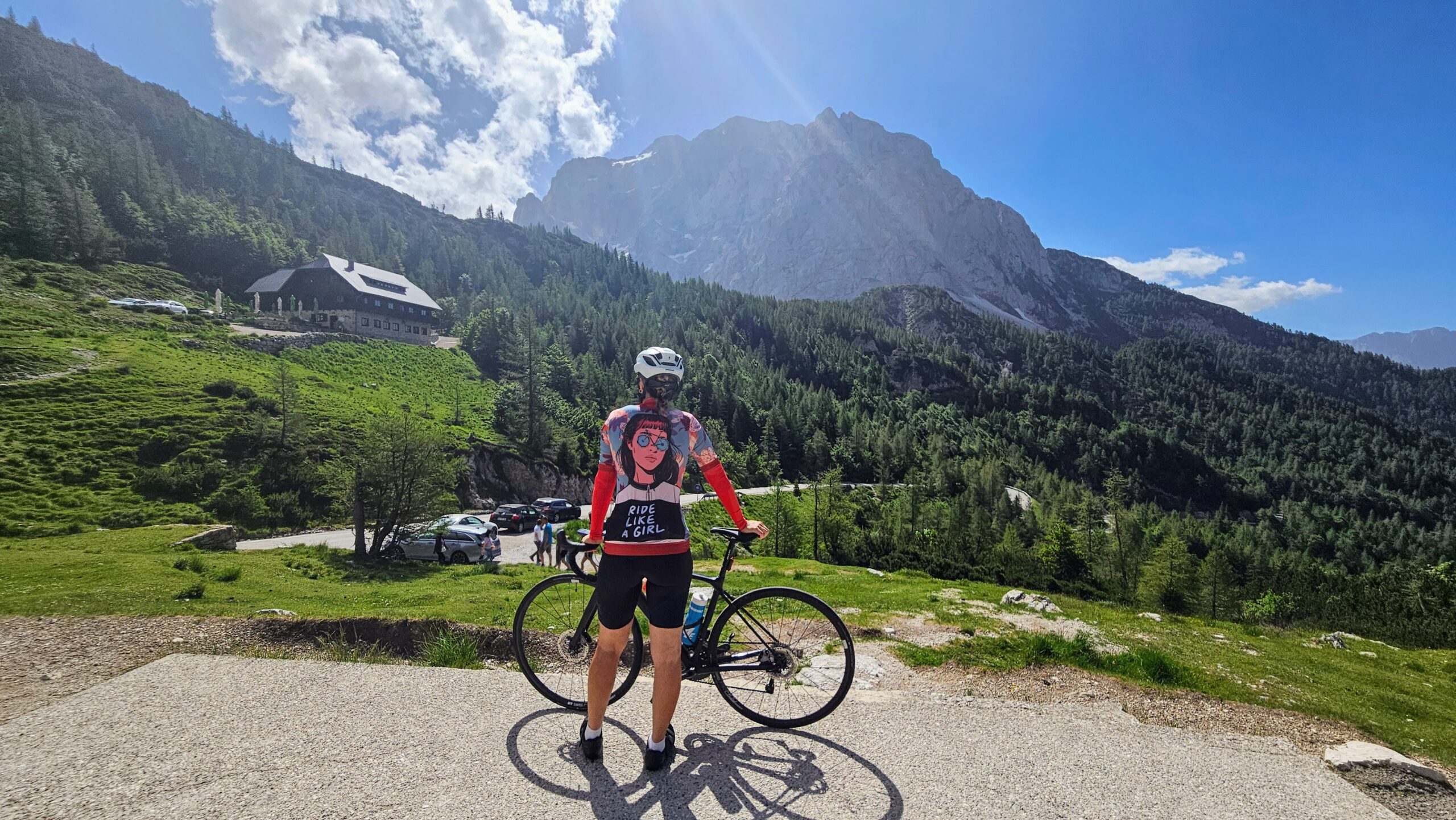
Here’s what actually happened: it was late 2025, I was sitting at my office and felt like my life had accumulated a few too many “this isn’t quite right” feelings in too short a time, and I found myself staring at the NorthCape4000 instagram account and webpage at 11pm on a Tuesday, reading the route description like a person who has completely reasonable control over their impulses. I did this continuously, for 3 weeks and in November I clicked register. I did not feel calm about it. I have not felt entirely calm about it since.
But the more I’ve sat with it — through training, through the logistics, through the long conversations with myself on long rides — the more I understand exactly why I did it, and why it was the right decision even if the timing was chaotic and the confidence was completely fabricated.
Something has to change
I’ll tell you what 2025 looked like for me without turning this into a therapy session, because this blog is about cycling, not grievances, but the context matters: it was a year of changes I hadn’t planned for. Professional uncertainty. Personal shifts. The specific kind of uncomfortable stillness that arrives when multiple things you relied on start moving at once and you realize you’ve been defining yourself mostly through things that turned out to be temporary.
There’s a well-known concept in organizational psychology called an identity earthquake — the moment when external structures you’ve built your sense of self around shift or disappear, forcing you to confront what actually remains. I didn’t go looking for that concept. I lived it first, then found the name for it later, which is often how it works.
What I knew, fairly clearly, was this: I needed something that was mine. Not mine in a passive sense — an interest, a hobby, a thing I did on weekends — but mine in the way that requires real commitment, real preparation, and real skin in the game. Something I could point to and say: I decided to do this, and I did it, and no external situation can take that from me.
NorthCape4000 – for me, a 3,000km unsupported cycling race to the top of Europe was, objectively, a lot. It was also, for reasons I couldn’t entirely articulate at the time, exactly the right size.
The thing Simon Sinek gets right (and what it actually means outside business)
Simon Sinek built an entire framework — the famous “Start With Why” — around the idea that purpose precedes everything else. People, organizations, decisions that start from a clear why sustain themselves in ways that “what” and “how” decisions never do, because the why is the thing that holds up under pressure.
I’ve used this framework in marketing strategy probably two hundred times. I’ve put it in decks. I’ve explained it to friends, coworkers and collegues. I apparently needed to apply it to my own life in a dramatic, bicycle-based way before it actually landed.
My “why” for NorthCape4000, distilled to a single sentence: I needed to prove to myself — not to anyone watching — that I am someone who does the thing, can do it alone, and not someone who thinks about doing the thing. That distinction has become everything. It’s what gets me on the bike on the training days I don’t feel like it. It’s what I come back to when the doubt gets loud, which it does, regularly, because the doubt never fully stops.
On the other side, Brené Brown writes in Daring Greatly that vulnerability is not weakness — it’s the willingness to show up when you can’t control the outcome. Signing up for NorthCape4000 was the most vulnerable thing I’ve done in years, not because the cycling scared me (it does, some of it), but because I told people I was going to do it before I was sure I could. The accountability isn’t a safety net here. It’s the whole point.
Setting a goal that scares you: What the research actually says
I’m a marketing professional by trade and some methods in marketing also work in your personal life, your branding.
Psychologist Gabriele Oettingen, whose WOOP framework (Wish, Outcome, Obstacle, Plan) is one of the most rigorously tested goal-setting tools in the literature, argues that pure positive visualization of achieving a goal actually reduces follow-through — because your brain experiences some of the reward without you having done the work. What actually drives action is the combination of imagining the goal and specifically planning for the obstacles. I’ve done more “planning for obstacles” around this project than I’ve ever done around anything, which, by this framework, is exactly right.
Carol Dweck’s growth mindset research adds the layer I find most personally relevant: people with a growth mindset — those who believe abilities are developed through effort, not fixed by nature — don’t just perform better, they enjoy the process differently. They experience difficulty as evidence of learning, not evidence of inadequacy. I am not naturally an ultra-distance cyclist. I am becoming one. That framing isn’t motivational spin. It’s the actual science of how skills develop.
What changed in one year
Between the registration click and the upcoming July 30th start date in Berlin, quite a lot has happened.
I kept working the long hours, but also figured out that my life needed restructuring. I built a training schedule and mostly kept to it. I tested gear in conditions I’d have avoided a year ago. I rode in the rain, in the cold, on days where everything about my body was suggesting strongly that the sofa was the better option. I started putting up this webpage and kept it to myself. I told more people than felt comfortable what I was actually planning, and discovered that vulnerability, as Brown suggests, usually invites connection rather than judgment.
To be completelly hones, I also, had a few panic sessions, made a spreadsheet that’s longer than several documents I’ve written professionally, and spent an impressive amount of time researching the best way to prevent saddle sores across 3,000 kilometers, which is information I now possess in unfortunate detail.
6 months ago, I was someone who wanted to do something big and hadn’t yet. That’s the thing that’s actually changed. Not the circumstances, not the perfect conditions, not the certainty — just the decision to start before those things arrived.
Why I’m writing about this here
This blog exists because I believe the gap between “I’m thinking about doing something” and “I’m actually doing it” is smaller than it looks, and the thing filling that gap is rarely ability — it’s usually permission. Permission to start imperfectly, to announce something before you’re ready, to be someone who does the thing without needing to be certain it’ll work out first.
For me, that thing is 3,000km of the NorthCape4000. For you, reading this, it might be your first 10km. The scale is different. The question is the same.
Tips & Takeaways
If you’re also standing at the edge of a big decision:
Give yourself permission to want the big thing. Not the reasonable version of it. The actual one that scares you slightly and that you’ve been quietly thinking about for longer than you’ve admitted.
Start with your why, not your how. The logistics of a big goal are solvable. A weak reason to care about it isn’t. Know what you’re actually after before you worry about the route.
Announce it before you feel ready. Public commitment isn’t about pressure — it’s about crossing the point where backing out quietly is still the easiest option. Cross that point on purpose.
Plan for obstacles specifically, not vaguely. “Something will probably go wrong” is not a plan for NorthCape4000. “When X happens, I will do Y” is. The WOOP framework is a 10-minute exercise that’s genuinely worth the 10 minutes.
Separate motivation from action. Motivation arrives and departs without warning. Don’t wait for it. Build a system — a schedule, a routine, an accountability structure — that runs even on the days the motivation doesn’t show up.
Next in the series: How I Prepared Mentally for NorthCape4000— because deciding is one thing, and showing up in your own head for 3,000km is a completely different challenge.
Leave a Reply